Showing posts with label vodou. Show all posts

Friday, March 16, 2007

Haiti Gives New Recognition to Vodou

Haiti Gives New Recognition to Vodou

It has no written scripture, is an amalgam of African, native, and colonial influences--and defines Haitian faith and culture
Kathie Klarreich,
Christian Science Monitor

PORT-AU-PRINCE, Haiti (April 6)--A young man, forlorn about his love life, stands in his shorts in front of the cross of Bawon Samdi, who in Vodou tradition heads the family of spirits of the cemetery. A Vodou priest, using herbal mixtures and chicken feathers, performs a ritual to cleanse the man's body and spirit. When the service is complete, the young man changes clothes, pays the priest, and heads home.

For many in the West and in upper Haitian society, Vodou--also spelled Voodoo, Vodoun, and Voudou--evokes a Hollywood stereotype of black magic and dolls stuck with pins.

But for Vodou supporters, what was once an underground practice dating back to slave days is finally being acknowledged as a bona fide religion and recognized for its role in defining Haitian culture. Vodou, which has no written scriptural text, is an amalgam of beliefs taken from African, native, and the colonial cultures that shaped modern Haiti.

The Roman Catholic and Protestant churches in Haiti have a long history of trying to discourage Vodou, seeing aspects of the faith as incompatible with their basic tenets. These include the worship of many spiritual beings, or lwa; a belief in possession; the use spells and incantations for good and, in some cases, for evil; and the use of animal sacrifices for some ceremonies.

Culture minister Jean Robert Vaval is among those working to improve Vodou's image. He recently helped arrange an exhibit of sequined Vodou banners and mock altars at the Musee d'Art Haitien in the capital, Port-au-Prince.

"We have maintained our heritage through Vodou," Mr. Vaval said. "We were brought over here from Africa, from tribes that no longer exist. We got all mixed up into one people. From that point on we created, and a great source of our inspiration has been Vodou."

The Culture Ministry's float for this year's Carnival paid homage to a 1794 Vodou ceremony that led to the country's independence from France 10 years later in a rebellion led by a former slave.

For practitioners, or Vodouisans, Vodou rituals are part of a philosophy that ties individuals to society, their community, and the environment.

Although there are no official statistics, the conventional wisdom is that the country is 80 percent Roman Catholic, 15 percent Protestant--and 100 percent Vodou.

"Vodou provides, like all world religions, a profound spirituality," says Leslie Desmangles, professor of religion at Trinity College in Hartford, Conn. "It is a very strong, cohesive social force within the community, and the community extends beyond the visual community to include the spiritual world."

In a country overwhelmed by poverty, political instability, and poor health care, oungans and mambos--Vodou priests and priestesses--are consulted on everything from fertility to serious illness to property disputes and even politics.

"There has never been a Haitian president who hasn't used Vodou to promote his program on the Haitian people," says Desmangles. "Every president has used it to maintain power through theological language."

Former dictator Francois "Papa Doc" Duvalier, president from 1957 until his death in 1971, was notorious for his use of Vodou. Loyal clergy reputedly performed rituals to protect his personal paramilitary force, the Tonton Macoutes, from retribution as they terrorized the Haitian populace.

In contrast, former President Jean Bertrand Aristide was the first Haitian president to formally invite Vodou oungans and mambos to the National Palace during his 1991-95 administration, recognizing the role they play in shaping Haitian society.

"Vodou is a manifestation of our lives," says musician Wilfrid "Tido" Lavaud. "It is part of our culture and influences everything--from the way we talk, to how we eat, to the colors we use in our paintings and the rhythms we include in our songs."

Vodou is so entwined in Haiti's culture that it is practically impossible to separate the two, say supporters. Traditional Haitian dancers in bright costumes often are accompanied by drummers who pound out African-style rhythms to honor ancestors and specific spirits. Walking down the street, one sees veves--traditional designs meant to invoke a Vodou spirit--in buildings and windows.

In Haitian painting, green is often a tribute to Simbi, patron spirit of rain and drinking water, while pink is a reference to Erzulie, the patron of love.

"We are a people with a tremendous amount of imagination," says Pradel Henriquez, the Culture Ministry's director of artistic and literary creation. "Haitians are not profoundly happy, but they want to live their lives to the fullest."

Related Features

Background on Vodou
Vodoun Culture
U.S. State Department Report on Religion in Haiti
Voodoo: From Medicine to Zombies

Thursday, March 1, 2007

The Ancestors in Vodou

The Ancestors in Vodou


Ancestor worship can be defined as any variety of beliefs and practices concerned with spirits of the dead. In ancient times, this was exclusively dead people who were relatives. We all have feelings of loss when a loved one passes over into Ginen or however you define the other side of living. Today's modern religions are sadly equipped to help us understand our feelings and to deal with our losses. Vodou takes this particular form of worship and elevates to a true art.

Ancestor worship is widely distributed. It is practiced still today in Modern Nigeria and Sudan. In Africa, the dead are divided into three categories - the founders of clans, those who died before there were genealogical records, and the known dead. The founders is an echo of the king worship from ancient Egypt. The Egyptians did not have rites of ancestors, but the royal houses did worship the dead of their royal lines, there by preserving the rites of kingship and familial duty to honor and serve the dead. There are echoes of this in the family grave sites in Haiti, where drink and food is given to those buried in the family compound.

An interesting comparison to an old Samhain rite in British Craft tradition speaks of the Ancient Dead, The Newly Dead and the Unnamed Dead. The ritual pays honor to them, invites them to dine with the living, and to always know that they are remembered and loved. So even the distance of land and sea doesn't alter the need to recognize the ones who have gone before the living. We recognize them because we see ourselves in them. They are the survivors of time and space, still standing guard over us and protecting us.

You are the descendants of those survivors. They were men and women strong enough to fight off illness, danger and thrive. They prospered and ate well enough to bear children and raise them to maturity. Remember that when you feel that your life is too hard, or you just can't make it. You are here today because of your ancestor's will to live; because you have that same will.

In some areas of the world, there are placatory rites for the dead so that they do not haunt the living, or create disturbances. This has more to do with dispensing of emotions than with reverence and honor. Rites such as the Desounnen and Anbwa Mo are designed to help the living complete the work of the dying by placing them within the correct sphere of realization. We are not haunted by the dead. We are haunted by ourselves, by our inability to process the current situation (the death) thereby completing the act of transmutation that is symbolized by death. Our real knowledge is of this life, the one we can get our hands around. We can taste, see, feel, hear and smell this life. That is how human beings were designed to analyze the world around them. When we can no longer use our senses to grasp the situation in front of us, when our normal methods of perception are shattered by the realization that we have no analytical tools available, then we fear the thing/situation/idea that we are confronted with.

By looking to the ancestors and accepting their guidance, we have genuine empirical evidence as to the immortality of our existence. We have proof of what happens after the act of death is completed on this plane.

We have no metaphysical bias to prevent us from looking back to the ancestors for the origins and solutions to many of our problems. In simple fact, they are more like us than anyone else. We inherited not only their physical appearance, but also their predominant mental, emotional and spiritual traits . We think and feel like they did; our basic needs are more like theirs were. There are really two sources of holy truth. One is the universe around us, a manifestation of the underlying divine essence. The other is the universe within us, passed down from our ancestors as instinct, emotion, innate predisposition and perhaps even racial memories. By combining these sources of inner and outer wisdom, we can arrive at our own solutions to our questions.

Your ancestors are family members who are still interested in your affairs. Because they have crossed over doesn't mean they aren't curious and willing to help in this life still. If this wasn't the case, then there would be no strong ancestor cults around.

In Mexico, they celebrate Daio de Muerto - day of the Dead in October. Families go the graveyard, clean off the tombs, and have a picnic with their dearly departed. In New Orleans, this custom is observed on November 2, "All Souls Day". There, the dead are feted with special liquors, flowers and cakes, called soul cakes. All the tombs in the Lafayette cemetery #4 had special libation vessels. I had erroneously thought they were for flowers. Our guide was genuinely shocked when I suggested this possible use. "No ma'am," he answered in a thick New Orleans patois, "that's for sharing drink with the dead. Flowers just get laid on top."

New Orleans is also the place to witness the continual propitiation of the dead - especially at the tomb of Marie Laveau, the Vodou queen. Even the Catholic Church had to admit to her power - they paid for the lovely bronze plaque that marks her tomb in the cemetery. The faithful still leave flowers, alcohol, money and bricked crosses on the walls and ground surround the grave. The belief is that Marie will intercede for you on the other side. And not just tourists leave their pennies and wilted flowers - we saw the priests from the Vodou temple across the street come make an offering of fruit while we stood respectfully off to the side. Marie still holds sway with her flock - or is it because they still need her to do the work from the other side?

In cultures that practice ancestor worship, the living and the dead are quite often related, for death doesn't make you cease to be a member of your family. If your social status made you a member of a group, then you might be remembered in communal rites - those that honor a group or nation of people. Sometimes, if you were a powerful and respected person alive, you keep that attitude, even in death. And quite often, that attitude, that power becomes a predominate feature of the rites performed in your memory. Haitian Vodoun is derived from the Kongo rites of Western Africa. The richly ornamented flags, the "crowned" pakets, the elaborately decorated tombs all speak to the kingly processions and accouterments of the royal houses. In Egypt, the ancients were buried in highly stylized tombs, with elaborate coffins and myriad jewels and foods, all designed to keep up the courtly state of affairs. Haitian Vodou has continued this elaborate ornamentation of tombs. Throughout the countryside, family tombs are kept immaculately white washed, with flags and decorations ornamenting the surfaces and walls. There are often chairs to sit in, so you can "visit" with the dead. When entering a new lakou in Haiti, it is considered appropriate and respectful to first approach the family tombs and pour water - thus honoring the oldest and most knowledgeable of the family first.

A point to remember – rituals nearly always reflect the society or persons they are meant to uphold or remember in life.

Sometimes, one person so combined in his image all the qualities desired in a worthy ancestor, that he was no longer regarded as a deceased ancestor, but elevated to the status of a god. In the Third Dynasty of ancient Egypt, the architect Imhotep designed the Step Pyramid of Saqqara. So great were his accomplishments - architecture, medicine, art and science - that by the Eighteenth Dynasty, he was no longer regarded as a man, but as a god. In the Haitian world view, family members of great strength or wisdom are revered at special times throughout the year - their birthday, an anniversary, at Fet Gede. Through successive generations, they eventually become Lwa, served and feted along side others like Ogou and Freda.

So what is the benefit of revering your ancestors in Vodou? To begin with, some scholars believe that ancestors are "anthropocentric conceptions" meaning they have the capabilities and personalities that we do, added to which is a supernatural potency. In simple terms, they are us, but more powerful. They live, love, understand and communicate with us, while simultaneously existing on another plane of reality. Maintaining communion with them reflects on our need to have continuity in this life as well as intercession with higher levels of consciousness. Whether ancestral spirits are gods or intermediaries, communion with them is a form of transcendence of ordinary states of existence. This can be either the conscious or unconscious goal of the act of devotion.

Ancestors02We always tell our students to begin their journey into Vodou by building an ancestor altar. There are as many way of doing this as there are people actually doing it. Some basics: A space separate from the rest of the house. This is to show reverence and to allow a quiet atmosphere. White is the color of the Ancestors, symbolizing purity and spirit. Photos of the dearly departed, a white candle, a bowl of fresh water. Sit quietly and gaze at the pictures. Realize this is where you came from, and where you too, will eventually go. Please don't focus on things like "I never liked this uncle" or "my father hated me". A waste of time and it doesn't mean anything or have value in this religious practice. Vodou has some basic rules and ancestors is one of them. You may not like them, but they are yours, and their interest in you in preordained to be about you. So take that energy and use it!

Focus on the positive - that same uncle may have been a whiz at business. Your father might have had tough feelings for you, but he's gone now, and in a place where if he did do something bad, he's got to make recompense for it. They must look out for you -. And to focus on the negative doesn't help you. I know some folks want non-blood or unrelated ancestors. That's fine, but they are not in the same position to help you - they have their own relatives to focus on.

How do I know this - by all the years of practice that have gone before me. Because Regleman tells me this is so. And because at a recent fet for Mambo Erzulie Freda, she pointedly chastised one of the Sosyete members for having a loan with a "stranger". "Why didn't you go to your papa!" she scolded. "You don't go to strangers! You stay in the family! They will watch out for you! No stranger will do that!" It made me think of Karen McCarthy Brown's book Mama Lola. In one chapter, Mama Lola chided her folks, "You in you in. You out, you out."

Ayibobo to that statement. Pay attention to your dead - they are everlasting and ever loving to you, regardless. Pay them attention, and you will always have love on your side.

Copyright 2004 Patricia D. Scheu, Mambo Vye Zo Komande La Menfo, Daginen

Sunday, February 25, 2007

Dark Goddesses in Vodou

Dark Goddesses in Vodou

COPYRIGHT 1996 - Mambo Racine Sans Bout
No reproduction without consent of author


In modern neo-pagan traditions, female archetypes of power and aggression are sometimes called "dark goddesses", and many people interested in pagan traditions have written to me to ask me if such archetypes exist in Vodou.
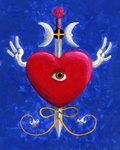
There are many female lwa in Vodou who sometimes behave aggressively, or who are regarded as particularly dangerous to those who offend them. I will discuss two of them here - Erzulie Dantor and Maman Brigitte.

ERZULIE DANTOR


There is an important group of female lwa in Vodou, whose first name is Erzulie. Erzulie Freda is a wealthy white woman, a promiscuous love goddess who moves in an atmosphere of perfume and luxury. Erzulie Dantor is a black woman who is represented pictorially with lithographs of the Roman Catholic "Saint Barbara Africana". Her tribal scars are evident on her cheek. She is heterosexual in the sense that she has a child, but she is also the patron lwa of lesbian women. In addition she is considered to be the wife of two lwa, Ti-Jean Petro and the very important magical lwa Simbi Makaya. When she appears at a ceremony through the mechanism of possession, she speaks a stammering monosyllable, "ke-ke-ke-ke-ke!" She likes knives, is much feared, and is considered the protector of both newly consecrated Houngans and Mambos, and of women who are experiencing domestic violence. Here are some songs for Erzulie Dantor.

Haitian Creole -
Erzulie fanm Ti-Jan metres kay la (repeat)
Pa rele, se ou pote houngan nivo,
Pa rele,se ou pote wanga pi fo,
Erzulie fanm Ti-Jan metres kay la, paket mwen tout mare.


English -
Erzulie Ti-Jean's woman, mistress of the house (repeat),
Don't yell, it's you who carries the new houngan,
Don't yell, it's you who carries the stronger spells,
Erzulie Ti-Jean's woman, mistress of the house,
my paket (a magical object) is all tied up.

And again:

Haitian Creole -
Set kout kouto, set kout pwenyad,
Prete m dedin a, pou m vomi san mwen,
(repeat)
San mwen ape koule.


English -
Seven stabs of the knife, seven stabs of the dagger,
Lend me the basin, so I can vomit my blood,
(repeat)
My blood is pouring down.
(Meaning, although Erzulie Dantor has received seven stabs of the knife and
is vomiting blood, she is strong, she can not be so easily destroyed.)

For a discussion of the imortance of Erzulie Dantor in Haitian women's lives, see the book "Mama Lola", an excellent work.

MAMAN BRIGITTE


Maman Brigitte, surprisingly enough for a lwa of a primarily African tradition, is British in origin, descended from Brigid/St. Brigit, the Celtic "triple goddess" of poetry, smithcraft, and healing. She must have come to Haiti in the hearts of deported Scottish and Irish indentured servants. There is even a song we sing in ceremonies which goes "Maman Brigitte, li soti nan anglete", Maman Brigitte, she comes from England...'.

Nowadays, Maman Brigitte is considered to be the wife of Baron Samedi, Master of the Cemetery and chief of all the departed ancestors, known as lwa Gede. The grave of the first woman buried in any cemetery in Haiti is consecrated to Maman Brigitte, and it is there that her ceremonial cross is erected. She is invoked to "raise the dead", meaning to cure and save those who are on the point of death from illness caused by magick. Here is a song about Maman Brigitte sung in Vodou ceremonies:

Haitian Creole -
Mesye la kwa avanse pou l we yo!
Maman Brigitte malad, li kouche sou do,
Pawol anpil pa leve le mo (les morts, Fr.)
Mare tet ou, mare vant ou, mare ren ou,
Yo prale we ki jan yap met a jenou.


English-
Gentlemen of the cross (deceased ancestors) advance for her to see them!
Maman Brigitte is sick, she lies down on her back,
A lot of talk won't raise the dead,
Tie up your head, tie up your belly, tie up your kidneys,
They will see how they will get down on their knees.
(Meaning, tie up your belly, 'gird up your loins' to prepare for the strain
of work, we will make the people who did this evil spell get down on their
knees to beg pardon and receive their punishment.)

Maman Brigitte, like the rest of the Baron/Ghede constellation, is a tough-talking lwa who uses a lot of obscenities. She drinks rum laced with hot pepper, so hot that a person not possessed by a lwa could never drink it. She also is known to pass hot Haitian peppers on the skin of her genitals, and this is the test to which women are subjected when they are suspected of "faking" possession. She dances the sexually suggestive and remarkably artistic banda, and the virtuosity of her dancing is legendary.

Every year on Fet Ghede (November 2, All Souls' Day), a national holiday is observed in Haiti. Thousands of people, dressed in white or in the violet-and-black of the Ghede lwa, stream into the streets. The first destination is the cemetery, where the crosses of Maman Brigitte and Baron Samedi (or Cemetiere, or La Croix, which are other aspects) are surrounded by supplicating men and women. They burn candles and beeswax tapers; make offerings of black coffee, roast peanuts, bread, and rum; and pray for protection, fertility, and other favors.

There are other lwa who might qualify as "dark goddesses", including Marinette, the Mambo who conducted the pig sacrifice at the ceremony at Bwa Caiman in 1884 which kicked off the Haitian slave revolution and led to the first independent black republic in the Western Hemisphere. Marinette must have been arthritic, because when she possesses a person, her hards are crabbed and stiff. In some peristyles (temples) during the highest initiation ceremony, the asogwe, the male lwa of ceremonial order Papa Loko runs the ceremony, but Marinette gives the asson (emblem of priesthood) to women, as she is the premiere Mambo. There is also a female lwa of the secret societies of the Shanpwel, named Reine (Queen) Alaou Pemba, but I will not discuss her because our secret societies are... well, secret. However, you may wish to check out The SANPWEL Page for more information on how these societies function.

Return to The VODOU Page.

A pretty article on Vodou in french

10 août 2004

chacun vit de l'esprit

Posté par lilitualski à 21:32 - Commentaires [0] - Rétroliens [0] - Permalien [#]

personne ne vit par la chair

« Le Vaudou était là, avant toutes les religions. Le vaudou est plus ancien que le Christ. Il est la première religion de la terre. Il est à la création même du monde. Le monde fut créé par le vaudou. Le monde fut créé par magie. Le premier magicien est Dieu, qui créa le monde de ses propres mains avec la poussière de la terre. Les peuples sont nés par magie dans toutes les régions du monde.

Personne ne vit par la chair.

Chacun vit de l’esprit.

Je peins pour montrer au monde entier ce qu’est le vaudou. Les trois quart des gens de part le monde croient que le vaudou est diabolique. Je peins pour montrer que ce n’est pas vrai. »

André Pierre – The sacred Art of Vodoo-
